

Your next marketing opportunity could be a buyer question you have yet to address, a service page that leaves an important decision unexplained, or useful content that needs to reach more people. It could also emerge from the results of work already published: a page reaching buyers through unexpected searches, or advertising whose reported performance gives you reason to reconsider the approach.
The purpose of Awesome Crew AI’s opportunity agent is to discover and prioritise the marketing work that can contribute most to your business objective, then use new research and observed results to reassess what is worth doing next.
The work starts with the researcher. Guided by your objective, it investigates demand and measures your business’s visibility alongside selected competitors. The opportunity agent combines that evidence with business context, your content portfolio, the available ad portfolio, planned work and available search and advertising performance. It explores where content or search advertising could make a useful contribution, compares possible actions and returns ranked opportunities for your team to review, select and plan.
Once your team has selected and planned the work, Awesome Crew AI executes it. The system carries out content and search advertising production, with your team contributing expertise, steering the work and approving what is ready to publish. As published work becomes part of your portfolio and new measurements and account reports become available, that evidence can inform the next opportunity assessment.
That closes the results loop: the next decision takes account of what you have already done, what is now being observed and where further work could still add value.
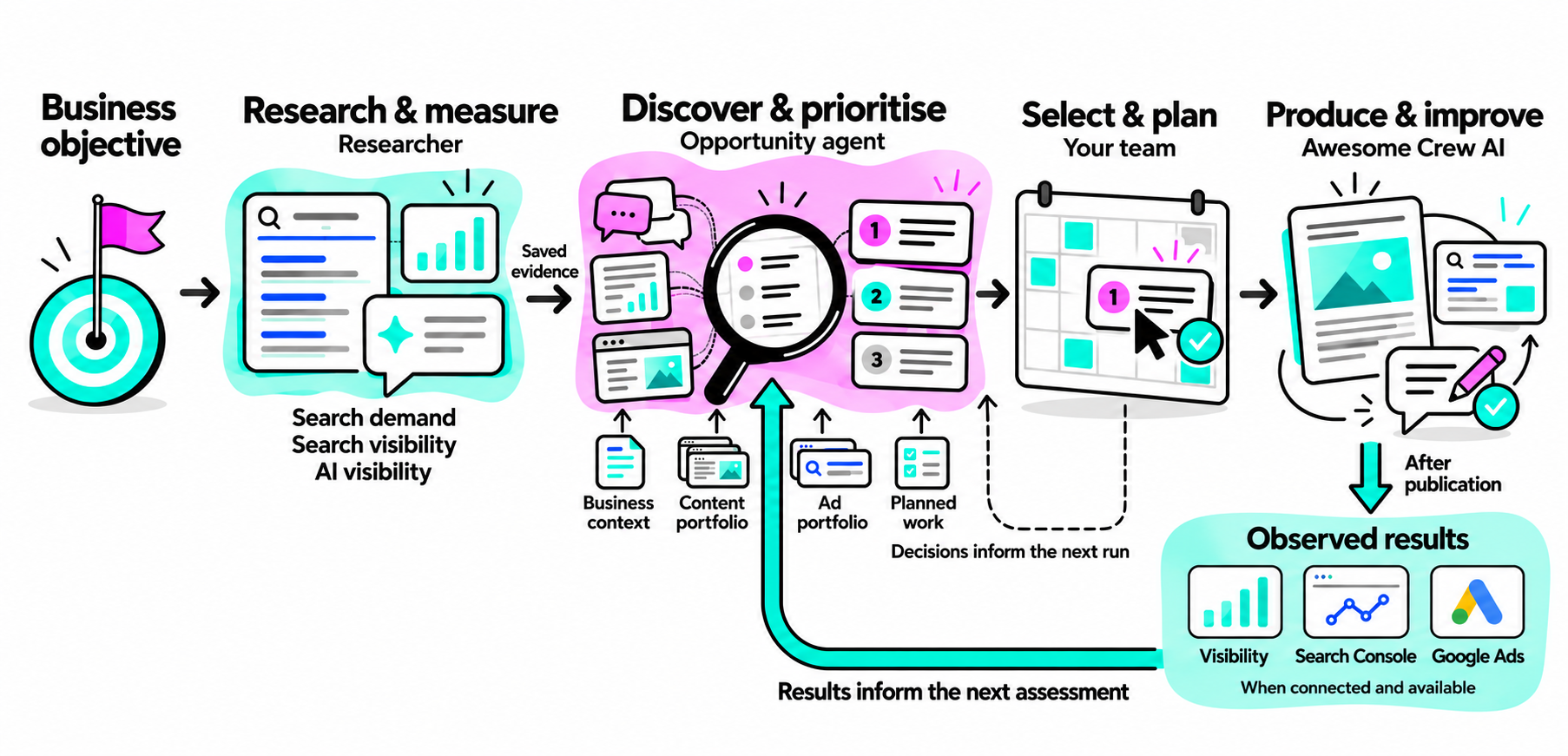
Research informs opportunities. Your team selects and plans; the system produces the work. After publication, fresh visibility measurements and available search and advertising results inform the next assessment. Human decisions remain part of every round.
The researcher establishes demand and measures visibility
A business objective gives the researcher a direction: the audience you want to reach, the needs you can serve and the markets and languages to investigate. It explores buyer language, discovers relevant search terms and questions, and assesses their fit with your business. That exploration helps determine what is worth measuring.
The researcher collects the evidence that will inform opportunity assessment:
- Search demand: provider measurements of search activity for relevant terms in the chosen market and language.
- Organic search visibility: where your website and selected competitors appear in the inspected search results.
- Sampled search ad visibility: when enabled, whether your business and competitors appear in the captured search ads.
- AI visibility: whether your business and competitors are mentioned or their websites cited in sampled answers to specific questions.
These findings are saved with their subjects, dates and measurement context. Subsequent research runs can refresh that picture. The opportunity agent reads the saved evidence during its own assessment, so research and opportunity generation can run at different rhythms.
Consider an illustrative example. A consultancy wants to attract enquiries from operations managers preparing a data migration. The researcher explores questions about disruption, preparation and choosing a delivery partner, measures relevant keyword demand and checks the consultancy’s and competitors’ visibility. That gives the opportunity agent a researched picture of the audience’s questions and the business’s presence around them.
The researcher establishes what the evidence shows about demand and visibility. The opportunity agent works out what useful marketing action could follow.
Bring observed results into the decision
Alongside the researcher’s measurements, the platform can collect performance from connected Google Search Console and import Google Ads reports. When those sources are connected and available for opportunity assessment, they add evidence of how existing marketing is reaching people.
Search Console shows which reported searches led to impressions and clicks for particular pages in a country. A page may already be reaching a relevant audience even when a separately sampled ranking check suggests limited visibility. That gives the agent a reason to inspect the page and reconsider the size or nature of the apparent gap.
Google Ads reports add observations such as impressions, clicks, cost and reported conversions for the ads covered by the import. The agent considers those results alongside the current campaigns, ad groups and destinations. A report of weak performance can change what is worth investigating; it does not, by itself, identify a faulty keyword or page. Reported conversions also retain the account’s measurement meaning, rather than becoming a count of qualified enquiries or verified revenue.
Where reporting coverage is sufficient, the system can compare current and previous 28-day periods. Comparisons require compatible dates and reporting definitions. Missing data remains unknown, and incomplete coverage does not become a misleading increase or decline.
Research, performance collection and opportunity assessment run separately. The agent reads saved evidence with its dates and scope. The results loop works by bringing fresh observations into later decisions, with enough context to judge what those observations actually support.
Turn audience evidence into potential opportunities
The opportunity agent connects the researcher’s findings with your business objective and what your company can credibly offer. It can examine an audience need through the relevant queries, their evidence and the pages receiving exposure. A question about migration disruption becomes interesting because it points to a decision the consultancy can help a buyer make.
It can also consider needs that buyers may not yet know how to express. Your business and audience context might support educational content about a problem with little measured search demand. The agent can explore that possibility while identifying the need as inferred. Needs directly expressed in the supplied evidence are marked as observed.
This allows the agent to consider both established demand and needs your audience is still learning to recognise, while keeping the basis for each opportunity clear. Its task is to identify a useful contribution towards the objective.
Identify what additional work could achieve
Understanding a relevant need opens an area to investigate. The next task is to discover what useful contribution your marketing could make there.
For the consultancy, suppose buyers need to understand how a migration could affect daily operations. The agent searches the saved content collection and reads relevant page passages. Its search combines matching words with matching meaning, helping it locate useful material even when the website uses different language from the buyer’s question. It can also inspect briefs for planned work and work in production.
Suppose the service page describes the migration process but says little about the customer’s preparation or operational trade-offs. A general migration guide is already planned. A focused improvement to the service page could help buyers assess what working with the consultancy would involve, complementing the broader guide.
The opportunity emerges from connecting three things: a buyer’s need, a question left unanswered and a contribution the business is equipped to make.
The agent is instructed to judge that additional contribution against the work already committed. A planned guide counts as something that will go ahead, even before it has been published. Further proposals must account for it.
That comparison helps direct effort towards work with a distinct purpose. Depending on what the agent finds, the valuable action could be a new resource, an improvement to an existing asset or further investigation into whether a gap exists. Where content coverage cannot be checked adequately, that uncertainty remains explicit.
Choose the action that addresses the obstacle
The opportunity agent considers content and search advertising together. This matters because helping a buyer involves both providing a useful answer and reaching the person who needs it.
In the consultancy example, improving the service page could help a buyer evaluate the service. If the page already answers the relevant questions, a supported search advertising opportunity could help suitable buyers reach it. When both actions have value, the agent should explain their separate contributions and any dependency between them.
Imported Google Ads context, when available, lets the agent inspect campaigns, ad groups and reported performance. That information can influence whether it proposes creating or improving an ad group, or creating a campaign. An improvement to an existing ad group requires inspection of that specific target.
Observed results can also weaken the case for more of the same work. Existing paid activity may already serve the need, or adverse results may call the proposed approach into question. A worthwhile advertising opportunity needs a supported contribution beyond those existing commitments. When a limited reach test is appropriate, its audience and learning goal should be explicit.
Content and advertising share one ranking, with no quota for either. A new article, a page improvement and a search advertising brief compete for attention according to their potential contribution to the objective.
This gives the agent scope to explore different routes to progress. A visibility gap becomes the starting point for choosing an appropriate response, with the audience’s obstacle guiding the choice.
Focus intelligence on the most promising next steps
The opportunity agent decides how to investigate within defined limits on time, research activity and cost. It chooses which sources to read, which content to examine, which earlier proposals to revisit and which alternatives to compare.
Its investigation builds on the researcher’s saved demand and visibility measurements, available search and advertising results, captured website content and content briefs. It uses those sources to follow a promising lead, check whether an apparent gap is already covered or compare a narrow improvement with a broader piece of work.
The opportunity agent is instructed to focus its investigation where another source read or comparison could uncover a useful opportunity or materially change a judgment. Once an idea is sufficiently supported, exploring another possibility may contribute more than repeatedly refining the same proposal.
Prioritisation brings those discoveries together. The agent weighs business fit, likely additional contribution, existing commitments, available performance evidence, uncertainty and effort. It ranks up to four opportunities from the evidence and alternatives investigated, aiming for a selection whose contributions complement one another. Other supported candidates can remain available, and it can select fewer than four—or submit no opportunities when the investigation has not established a supported proposal.
Confidence is separate from priority. A smaller improvement may be well supported, while a potentially larger opportunity carries more uncertainty. Keeping those judgments distinct helps your team weigh both the potential value and the strength of the evidence.
The output gives your team specific, prioritised proposals to choose from. People decide which opportunities enter the plan, setting the direction for the system’s production work.
Build on discovery as the business moves forward
Marketing priorities change as work gets planned, published work reaches an audience, evidence becomes available and teams make decisions. The agent maintains a continuing collection of opportunities, supported findings and unresolved questions so later assessments can build on that progress.
If the consultancy plans the service-page improvement, that commitment becomes part of the next assessment. The opportunity agent cannot rewrite the planned brief. It must evaluate further work in light of the updated plan.
Your reasons for dismissing a proposal also carry forward. You can indicate that similar work should be avoided or that a different approach to the same need would be welcome. That feedback helps direct subsequent exploration.
Open questions preserve promising areas that need more investigation. The agent might identify a possible need for migration-cost guidance but lack enough evidence to support its value. It can retain that question for a later run. Further evidence might support a new opportunity, change its scope or show that existing coverage is sufficient.
This continuity lets discovery accumulate. Later runs can add opportunities, refine available proposals and change priorities while retaining previous work. Your team’s decisions and newly available results become part of the context for finding the next useful contribution. The learning happens through this saved evidence and decision history, which gives each assessment more context to work with.
From human selection and planning to system execution
The next step is human selection and planning. Your team reviews the opportunities, chooses which to pursue and adds them to the plan. Each new or revised proposal describes the audience need, its supporting basis, the current coverage, the gap and the proposed response, giving people the context to make that choice.
For the consultancy, the resulting brief might be:
Improve the migration service page so operations managers can assess the preparation and operational trade-offs involved in working with the consultancy. Explain what the customer team needs to prepare and which questions to discuss before starting. Build on the existing service explanation and complement the general migration guide already planned.
If the consultancy selects and plans this opportunity, the platform develops the revised copy. The audience questions, evidence and intended improvement travel with the brief into production. The consultancy’s specialists contribute practical details about preparation and delivery, correct assumptions and review whether the result reflects their experience. The system incorporates that input as the work develops.
The same division of responsibility extends across the platform: people select and plan opportunities; the system executes the planned content and advertising work. Your team supplies expertise, makes creative choices, gives feedback and approves the result. For long-form content, that includes choosing between proposed concept directions before drafting. The platform manages production and revisions around those contributions, while people decide what is ready to publish.
This connects the opportunity agent’s judgment to execution. The need it discovered and the contribution it identified guide the work the system produces. Once that work is published and observations become available, the results loop brings the assessment back to the same practical question: what additional work is worth doing now?
Let results change the next recommendation
Return to the consultancy after it has published the service-page improvement. A later assessment can consider the updated page, the broader guide’s current status, refreshed visibility research and available Search Console observations. The page is now part of the existing portfolio, so a further proposal has to explain what it would add beyond that work.
Suppose Search Console shows that preparation-related searches are already bringing the page impressions and clicks. That qualifies an earlier picture of weak organic reach. After reading the page and considering the other evidence, the agent might lower the priority of another guide on the same topic and investigate a different buyer need. Or it might find that the existing explanation is useful but a distinct, well-supported advertising test could help another relevant audience reach it.
If advertising has also run, available reports can inform a later assessment of whether further paid work deserves attention. The agent still needs to inspect the relevant account context and explain the proposed contribution. Connecting an ad to its destination page helps it investigate; that relationship does not prove which keyword or page change caused the reported outcome.
This is an illustrative sequence, not a claim that a particular edit caused a performance change. The useful shift is in the decision: an earlier assumption can be qualified, a proposal can be revised, and a different next step can become more valuable. Your team then chooses what enters the plan. Existing commitments remain protected.
Keep marketing effort focused on what can add value next
The opportunity agent’s value is the direction it gives to marketing effort. It connects audience needs and your business objective with what you already have, what you have committed to produce and what available results now show. From that evidence, it proposes the additional work worth considering.
The researcher investigates demand and measures visibility. Your team selects and plans opportunities. Awesome Crew AI executes the production work with your expertise and review. After publication, new measurements and connected performance reports can feed the next assessment. The reasoning continues beyond the brief and the finished asset.
The result is a marketing cycle in which each next decision can draw on what came before. Your team can build on useful work, reconsider assumptions and direct effort towards the next supported contribution to the objective. That is the value of the results loop: research leads to action, action produces observable results, and those results help determine where marketing effort should go next.