

Your audience may describe a problem differently from the way your business describes its services. A buyer might search for help preparing a project, compare possible approaches or ask an AI assistant what to consider before choosing a provider. Understanding those needs gives your marketing a direction. Measuring where your business appears helps you see how visible you are around them.
The purpose of Awesome Crew AI’s research agent is to investigate relevant audience needs, establish what the available evidence shows about search demand and measure your business’s visibility.
The researcher starts with your business objective, audience questions and company context. It explores search language, assesses which discoveries fit your offering and organises them around the needs your audience is trying to address. It then measures selected keywords and AI prompts in organic search, sampled search ads and web-enabled AI answers, alongside your chosen competitors.
That work builds a continuing research inventory. Later runs can use saved findings, investigate further questions and refresh visibility measurements. The separate opportunity agent draws on this evidence to assess where content or search advertising could make a useful contribution. Your team selects and plans the work, and Awesome Crew AI carries it through production with your expertise and review.
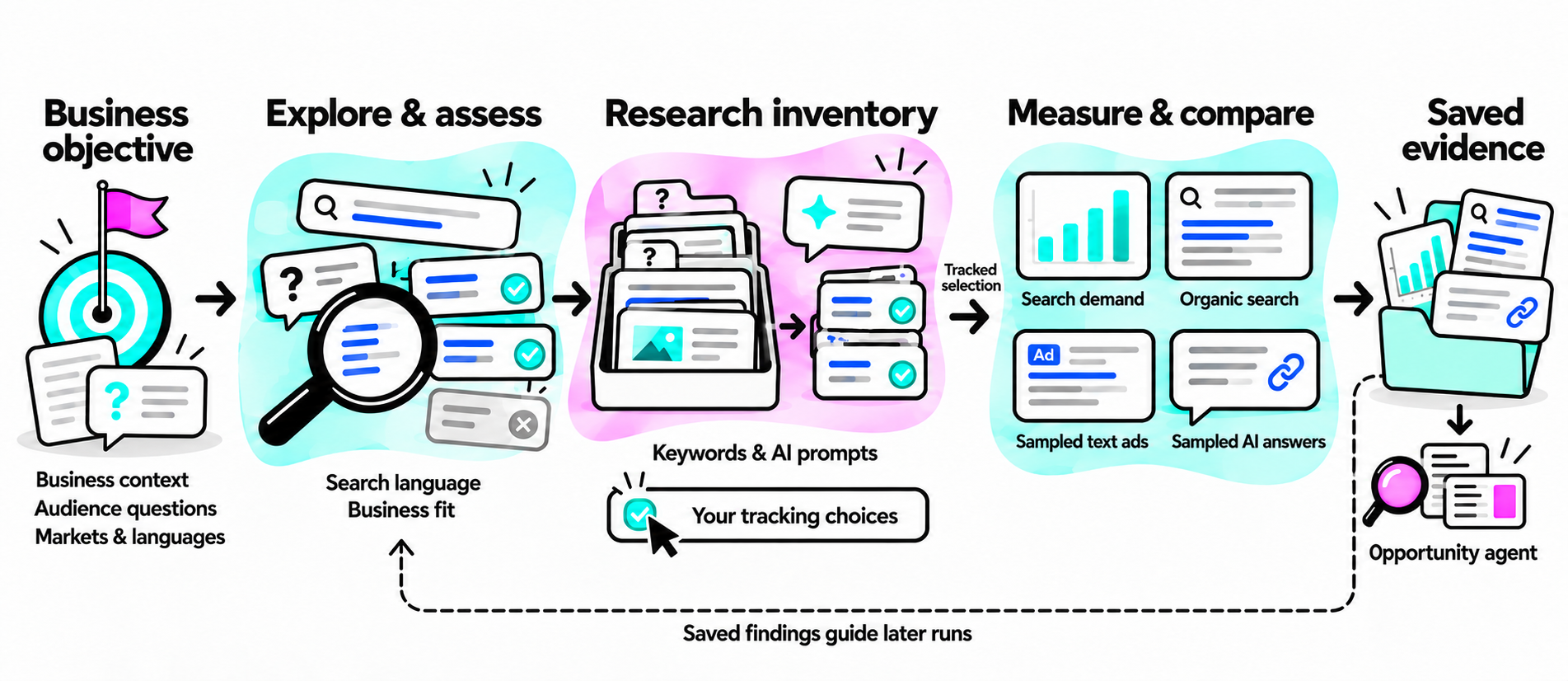
Your objective guides discovery. The research inventory retains relevant findings, tracking determines what is measured, and saved evidence informs opportunity assessment and later research runs.
View the illustration at full size.
Start with the business objective and the audience
A useful investigation needs a purpose. Your objective identifies the business outcome you want to support, while audience intents describe the problems or decisions that matter to the people you want to reach. Research questions give those needs a more specific focus.
Consider an illustrative example. A consultancy wants to attract enquiries from operations managers preparing a data migration. Its audience needs to assess disruption, understand the preparation involved and choose a suitable delivery partner. A research question might ask what a customer team needs to prepare before a migration begins.
That question guides discovery. A seed phrase such as “data migration preparation” gives the researcher starting vocabulary for exploring related search language. The researcher can later select an exact AI prompt, such as “What should an operations team prepare before a data migration?”, to sample how an AI assistant answers that need.
Each serves a different purpose: the question organises the investigation, the keyword supports search measurement and the AI prompt defines the wording used to sample AI answers.
Your documented business context helps the agent judge fit. The offering, audience, selected website and competitor profiles give meaning to the phrases it encounters. Configured markets and languages define where the research applies, keeping measurements attached to the geography and language they represent.
Follow promising questions into relevant search language
The researcher chooses a useful question to investigate and combines two sources of possible language. The model proposes phrases informed by your business and audience context. A keyword provider returns related search terms and available demand signals from the selected seeds.
The agent assesses each new candidate against the wider objective. A phrase has to express a relevant need and belong somewhere in the research inventory. High search volume or an expensive advertising bid cannot establish that fit on its own.
For the consultancy, an investigation into preparation might uncover a phrase about choosing a migration partner. The researcher can place it under an existing provider-selection question. If accepted discoveries reveal a distinct need that the current questions do not cover, it can create a focused question under a relevant audience intent.
This lets the investigation develop beyond its starting vocabulary. It also keeps discoveries connected to what a buyer is trying to do. A search for a competing provider’s login would normally fall outside that open audience need; a relevant comparison between delivery approaches could contribute to it.
The researcher decides where further exploration looks useful within a bounded allowance. It can follow a promising branch, open another question or stop. Previous results help inform that choice, including whether recent investigations added evidence of distinct demand. Some questions may remain unexplored for a later run.
Discovery builds a researched view of relevant needs and language. Its progress depends on what the investigation learns, including when another batch adds little useful evidence.
Give search demand a clear meaning
Accepted phrases can receive direct demand checks, giving the inventory quantitative evidence as well as a judgment about relevance. The researcher retains useful candidates beyond those directly checked during discovery, with their measurement status attached.
Direct demand measurement uses a defined monthly period. By default, it covers twelve months ending two calendar months before the run begins. The result is an average of the complete monthly series for that period, in the selected market and language. It provides a view of search activity over time.
A volume supplied during keyword discovery is retained separately as a discovery estimate. Missing monthly data remains unavailable. A measured zero means a usable series returned zero; an incomplete response cannot establish the same conclusion.
The researcher also handles supported relationships between close variants. Where the evidence establishes that several phrases share a demand estimate, aggregation counts that group once. The inventory can preserve the individual phrases while normally tracking one automatic representative. Unresolved overlap remains visible, and estimated searches should be interpreted as search activity rather than a count of individual buyers.
For the consultancy, this helps distinguish additional demand evidence from another spelling of a phrase already known. Advertising price and competition signals provide further market context, while relevance still depends on the audience need and the business’s ability to serve it.
Measure visibility around the selected needs
Discovery leads into a separate measurement stage. The system saves a worklist for eligible tracked keywords and exact AI prompts. New or due keywords receive demand checks, while acceptable recent demand assessments can be reused. Search and AI observations follow their own measurement work.
This separation keeps the recurring panel useful even when an investigation stops exploring. The researcher can finish discovery and still have selected visibility measurements to complete.
The panel brings together three views:
- Organic search visibility: Google result captures show where your website and selected competitors appear for tracked keywords. The researcher saves matching URLs and positions, together with the actual usable depth returned. “Not found” applies to that inspected result set.
- Sampled search ad visibility: when enabled, the researcher records whether page-one text ads from your business or competitors appear in the captured search results. This can be observed without connecting a Google Ads account. It describes sampled ad presence; campaign spend, clicks and performance require separate account data.
- Sampled AI visibility: the researcher asks exact tracked questions through a defined OpenAI panel, with web research requested. The default panel collects three answers per query and saves the responses, sources and observations of brand names and website citations.
For the consultancy, an AI sample might show whether its name appears in an answer about preparing a migration, whether its website is cited, or both. Those observations remain distinct. The chosen prompt is a hypothesis about a useful audience question, so the panel measures responses to that prompt without claiming how often buyers ask it.
Together, these observations show your presence within the selected search terms, questions and competitor panel. Saved answers and ranking URLs provide context for interpreting the figures.
Keep the measurement panel useful and under your control
The research inventory can hold more relevant discoveries than the recurring panel tracks. This gives you room to retain useful language while keeping ongoing measurement focused.
New eligible discoveries can join tracking when capacity permits. Once the panel is full, further accepted candidates remain available for consideration. A separate review can propose replacing researcher-managed targets where a different selection would provide more useful coverage of distinct needs.
Your explicit tracking choices take precedence. You can keep an important keyword or AI query tracked, untrack it or return that decision to the researcher. Protected choices constrain automatic replacements. Assignment locks preserve the way you have placed targets, while exclusions control which phrases or prompts are eligible.
These controls serve different purposes. A seed can guide discovery without being tracked. Turning off discovery for a question leaves its existing keywords and AI prompts subject to their own tracking settings. You can therefore pause exploration of a well-understood area while continuing to measure your presence there.
In the consultancy example, the team might protect a strategically important preparation term even if its measured volume is modest. The researcher can continue exploring related language around that choice, with useful candidates retained for a later review.
Build on what previous research has established
Each run contributes to saved knowledge about the objective, market and language. The inventory retains accepted discoveries, relevant rejection decisions, observations and research history. Later runs use compatible information to decide what is worth investigating next.
After exploring preparation, the consultancy’s next run might examine the division of responsibilities between customer and provider. It can use existing questions and keyword evidence to avoid treating every familiar phrase as a new discovery. Recent research yield helps determine the allowance for further exploration, with room for continued investigation when earlier branches have become less productive.
Organising the inventory also need not erase the evidence. Moving an unchanged keyword to a better question can preserve compatible measurements. Changing its wording creates a different measurement subject, so older observations cannot simply become evidence for the new phrase.
The same continuity applies during execution. Completed measurements are saved as work progresses. If a supported measurement failure interrupts completion, successful results remain available and the recovery path can target missing work. Each run still has an endpoint; recurring research starts further bounded runs on the configured schedule.
This makes the inventory a developing understanding of the audience. A later run can add a relevant branch, clarify an uncertain demand result or reveal a change in visibility. The contribution may be better evidence about a known need as well as the discovery of a new one.
Read changes in the context of what was measured
The report calculates metrics from saved evidence. It brings together tracked demand, organic presence, sampled AI visibility and, when enabled, sampled paid text-ad presence. Views by audience intent, market and language help connect the results to the questions behind the research.
Coverage matters when reading those figures. A search observation with limited depth supports conclusions within that depth. A failed provider request remains an operational failure. No data, stale evidence and measured zero retain their different meanings, so uncertainty stays attached to the result it affects.
Comparisons also account for changes to the panel. Suppose the consultancy adds several preparation keywords. The total demand represented by its tracked inventory may increase because the research now covers more language. To assess visibility change, weekly comparisons match subjects measured at both endpoints and identify newly measured subjects separately.
That distinction helps your team understand whether the picture changed because visibility moved, the research expanded or both. Dates and measurement periods provide further context: a recent visibility observation can sit alongside a still-usable demand assessment covering an earlier twelve-month period.
Give opportunity assessment a researched foundation
The research agent gives the next stage specific evidence to work with: relevant audience questions, search demand assessments and observations of where your business and competitors appear. The opportunity agent combines that foundation with business context, inspected content, available advertising information and work already planned.
For the consultancy, research might establish relevant preparation language and limited visibility around the selected terms. Opportunity assessment then investigates what response would help. It could find that the service page needs a clearer explanation of customer responsibilities, that a planned guide already addresses the need, or that useful existing content could benefit from additional reach.
The appropriate action depends on that further assessment. A relevant keyword gives the team an area to consider; the opportunity agent must explain the additional contribution of a particular piece of work.
The research agent connects your business objective to an expanding body of audience evidence and repeatable visibility measurements. That foundation gives opportunity assessment a clearer starting point and gives your team context for choosing the work that follows. As research continues, saved findings and your decisions help direct the next investigation towards what remains useful to understand.